
The drive home
How the men who paid to shoot at Sarajevo went home, slept, and were never found out. On guilt, and who it was ever for.

Do something terrible enough, we tell ourselves, and it will eat you alive. Eleven thousand people died in the siege of Sarajevo, and some of the men who paid to help kill them went home, slept in their own beds, and were never, as far as anyone could see, eaten by anything.
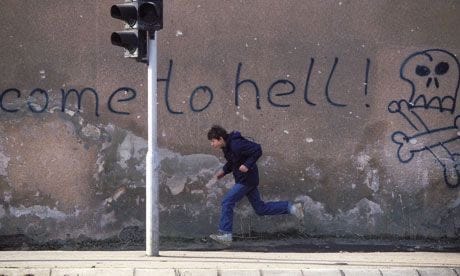
The allegation sitting with a prosecutor in Milan goes like this. For four years in the nineties Sarajevo was under siege. The city lies in a valley, the men besieging it held the hills above, and snipers fired down into the streets at whoever crossed them. That part is history. What’s new is the claim that rich foreigners bought their way in for the weekend. Businessmen, dentists, gun hobbyists, men from all walks of life. They’d meet in Trieste, drive down through Belgrade, get walked up into the hills and hand over something like a hundred grand for a rifle and an afternoon of shooting at innocent civilians. They shot at people crossing the road to get water. They shot at kids. They shot at people in their houses. Somebody, at some point, started calling it a safari. None of it is proven. But the testimony has been coming for thirty years, from too many directions to be nothing.
The first man they’ve named is eighty, a retired truck driver, living somewhere quiet in the north of Italy. That’s the bit I can’t get past. Not a warlord. Not a man with a record. A truck driver, who when the afternoon was over, probably got in his car and drove home through Belgrade and Trieste, right up to his own front door, put his keys down and went to work on Monday. Thirty years. Nobody noticed anything.
What we want is for him to have been wearing a costume. That the quiet life was a front and the real man was underneath it, something else, something that would be easily recognisable as pure evil. Every documentary about people like this reaches for that, and I don’t believe it, mostly because thirty years is far too long to keep a front up. Whatever he was on Monday morning was what he actually was. Something in him was broken, obviously, you don’t do this otherwise. But it didn’t break on the hill. It broke slowly, over years, and he did it himself, the way anything breaks if you keep working at it. And if a man can do that to himself while looking normal the entire time, I don’t think the rest of us get to sit in the gallery and watch.
Start with the thing that was supposed to stop him. Guilt.
We talk about guilt like it’s a set of scales. Small wrong, small pang. Enormous wrong and it flattens you. We need that, because it’s the last bit of fairness going: if the law never finds him, at least the guilt will. But guilt has never worked like that and you don’t need a study to know it, just take your own week. This week I’ve lost a night’s sleep over one sharp sentence said to someone I love. A man can put a stranger in a scope and pull the trigger and by the looks of it, feel nothing. If guilt measured harm, that man couldn’t exist. History is full of him. Massacre, after massacre, then sound sleep.
So it’s measuring something else, and I think what it measures is how much the person counted to you in the first place. Hurt someone inside your circle and it’ll chew on you for years. Hurt someone outside it and there’s just nothing there, and not because your conscience broke. It was never pointed that way. It doesn’t ask what you did. It asks who you did it to.
Which is why the word safari does more work than it looks like it does. It wasn’t dark humour bolted on afterwards. It’s the thing that made the afternoon possible, because once you’ve called the people in the street game, they’ve stopped counting before anyone touches a trigger, and then guilt looks the whole thing over, finds nobody in it, and stays quiet and these men also had each other. A small audience who thought the trip was impressive rather than sick. And shame in front of a crowd that’s impressed doesn’t just go quiet, it comes back round as pride. So nothing had to break in them that day. It was already done.
I don’t think there’s a wall between ordinary people and this. I used to. There’s just the question of who counts to you, and that gets settled years before anyone offers you a rifle.
Which leaves the rest of us, and this is the part I’ve been circling for weeks.
Nobody wakes up able to shoot a stranger for sport. You make yourself able, over a long time, in increments too small to notice while you’re making them. A contempt you let settle instead of picking at. An ugly word you take up without asking what it’s for. A kind of person you gradually stop seeing properly. The migrant, the beggar, the wrong voter, whoever it is for you. Each one counts a bit less than the last and every step feels like nothing, because every step is normal. Aristotle said we become unjust by doing unjust things, which sounds obvious until you sit with it. Character isn’t what you were handed. It’s what you’ve been practising. And everyone’s practising something.
So the honest answer to could I ever isn’t no. It’s not yet, and hopefully never. He wasn’t another species. He was further down a road I’m standing on.
There’s also the fact that he invented none of it. The words that shrink people, the small warm pleasure of despising someone from a safe distance, the whole business of deciding who counts, none of that was his. It got handed to him, and it’s being handed around now, kept warm by use, by us. He just took it further than we do. Karl Jaspers, went at this after the 2nd world war, trying to work out what ordinary Germans owed for things they never personally did, and underneath all the legal answers he ended up somewhere simple: they came from us. Same stock, same habits, same jokes. Nothing to do with me is the lie.
And then the last thing, which is the one that actually keeps me up, because it hasn’t stopped happening.
For thirty years nobody noticed. We say that like it’s a footnote. It’s the whole thing. What hid him wasn’t cleverness, it was normality, the general agreement that a quiet man with a pension and a clean record isn’t worth a second look. And we all know better than that. Nobody’s life is normal from the inside. You know what’s actually in your head, the mess of it, the stuff no neighbour would ever guess watching you take the bins out. But the honesty we can’t avoid about ourselves, we don’t extend outward. We hand everyone else the assumption instead. Calm face, clean history.
He didn’t build that cover. We did, and we’re still building it, around whoever else came down off those hills and drove home. Someone is handing one of them a coffee this morning. Someone’s waving at him. His grandchildren love him. Every one of those things is saying the same thing, which is normal, nothing here, move along.
So am I saying we’re all guilty. Not of Sarajevo, no. But of something slower, yes, I think so. Of carrying the same capacity around and quietly feeding it. Of keeping the habits alive that the whole thing ran on. Of building the hiding place, and then not looking at it. Guilty the way you’re guilty of a fire that never caught. Kindling laid, match in the drawer, with nothing else missing but the wind.
I’ve stopped asking whether I’d have pulled the trigger. It’s a vain question. Asking it turns the whole thing into a daydream where I’m the one up on the hillside being tested, and I pass. The real one is smaller and I like it a lot less. Who’s already started counting for less with me. That’s where this gets decided, not in some nerve you find at the last second, but in the dull unwatched daily work of keeping people counted as people. Everyone’s on that job. Most of us don’t know we’ve clocked in.
Those men gave it up long before anyone paid anyone. By the time the rifle was in their hands , money handed over, the seeing was already done. Then they drove home and became neighbours, and colleagues, and somebody’s granddad. Normal men. Normal was never the alibi. It was the cover.